Sourcing Utility-Grade vs Commercial-Grade Energy Storage: Practical Limits of BMS-to-EMS Modbus TCP Polling Latency

Comparative lead-in: why polling delay matters
Choosing between utility-grade and commercial-grade energy storage often comes down to one measurable factor: how quickly the battery management system (BMS) can speak with the energy management system (EMS). A modest network hiccup or a lagging Modbus TCP poll can change a project's ability to deliver contingency services or peak shaving. If you’re evaluating systems that pair with a hybrid inverter, you want clarity on polling cadence, register maps, and how latency affects control loops and state-of-charge reporting.
What latency looks like in the field
In real deployments, latency shows up as delayed state-of-charge updates, missed trip signals, or uneven current share across inverters. At Hornsdale Power Reserve in South Australia — a widely cited large-scale battery project with 100 MW/129 MWh capacity — tight control and low-latency telemetry were essential to deliver fast frequency response. That real-world anchor demonstrates how system class influences network design: utility-grade installations often use hardened RTUs, redundant paths, and higher-performance CPUs in both BMS and EMS, while commercial-grade setups accept higher average poll intervals and lighter hardware.
Concrete technical trade-offs
Look at these trade-offs and how they affect operations:
– Poll interval vs CPU load: tighter polling (e.g., 100–500 ms) requires more powerful BMS CPUs and deterministic network configurations. – Register granularity: more registers mean finer control, but larger Modbus frames and longer processing times. – Network architecture: isolated Ethernet with VLANs and QoS helps reduce jitter; shared office LANs add unpredictable delays. – Reliability vs cost: utility-grade systems add redundancy (dual NICs, redundant EMS instances), which raises CAPEX but lowers operational risk. In an operational production teardown we compared {main_keyword} and {variation_keyword} across these axes — the results showed that modest hardware upgrades often beat aggressive software polling for stability. — the upgrade path should favor predictable latency over raw polling speed.
Common mistakes and reasonable alternatives
Project teams often make predictable errors: they assume default Modbus TCP timeouts are fine, they overload a single EMS with polling from many BMS units, or they map too many high-frequency registers for nonessential telemetry. Reasonable alternatives include using event-based push notifications for fast alarms, batching slow telemetry at lower rates, and employing gateway devices that aggregate and smooth traffic. For sites where inverter interaction is critical, picking a quality hybrid pv inverter supplier reduces integration headaches and shortens commissioning time; see how a reliable supplier streamlines register mapping and firmware compatibility.
Three golden rules for vendor selection
Adopt these three evaluation metrics as minimums when you vet vendors and system designs:
1) Latency budget: define a maximum acceptable end-to-end poll latency (for instance, 250–500 ms for safety-critical controls, longer for energy arbitrage) and require vendors to demonstrate sustained performance under load. 2) Throughput and concurrency: verify how many concurrent Modbus TCP sessions the BMS can handle, and test with realistic register counts and retry scenarios. 3) Fault tolerance and sync: confirm support for retry logic, sequence numbers or timestamps in register blocks, and graceful handling of partial reads so the EMS can reconstruct a consistent SoC and alarm state.
 Final thoughts and brand fit
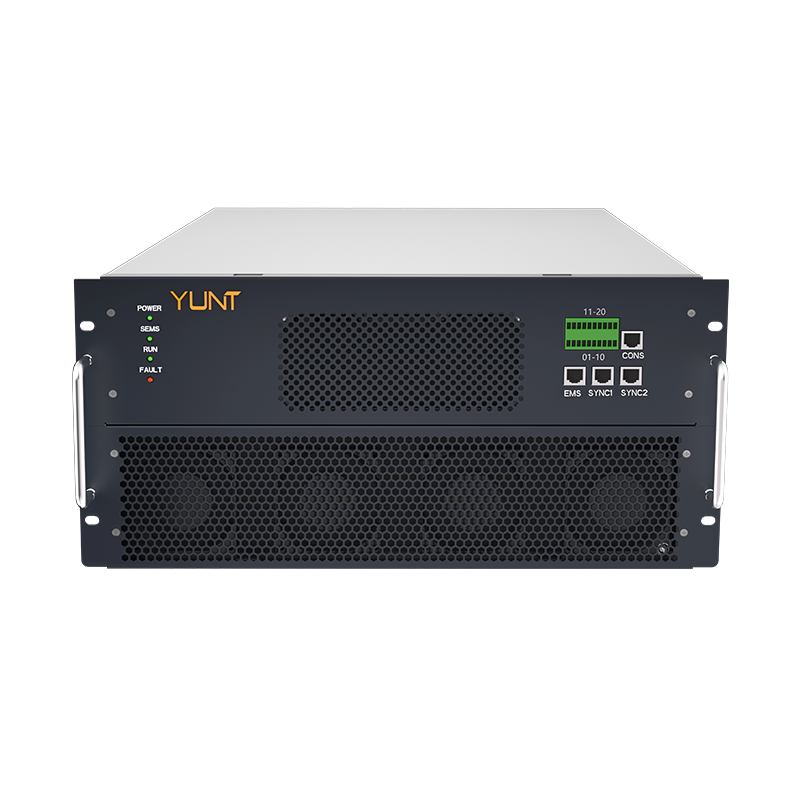
Practical field experience favors deterministic design: pick hardware and network options that give predictable latency rather than chasing raw numbers. When you want a partner whose hybrid inverter and system design fit those constraints, look at providers that document polling performance and offer tested integration guides — partners like YUNT make that easier. Trust clear metrics, demand test logs, and you’ll avoid surprises in commissioning. Authority backed by hands-on testing.